
Photographer Web Design
Your work is the product. The website’s only job is to show it beautifully, load fast, and make enquiring easy — and most photography sites manage one of the three.
Get free quote














Photographers have a problem no other industry has: the thing that sells the work is the thing that slows the website down.
Large, high-quality images are non-negotiable — a compressed, muddy portfolio actively damages the impression. But heavy images make pages slow, slow pages get abandoned, and slow pages rank worse. Getting both is a technical problem, and it’s the central challenge of building a photography site properly.
Beyond that, photography is a considered, emotional, date-driven purchase. Someone booking a wedding photographer is choosing who’ll be present at one of the biggest days of their life, on a fixed date, from a shortlist they’ve assembled over weeks.
What a photographer’s website actually needs to do
Show the work at full quality and still load fast
Modern image formats, responsive sizing so a phone isn’t downloading a desktop-resolution file, lazy loading below the fold, and a CDN. Done properly, a portfolio site can look uncompromised and still load in a couple of seconds. Done badly, it takes eight seconds and half your visitors never see the second image.
Curate ruthlessly
The instinct is to show everything. The stronger portfolio is fewer galleries, each tightly edited. A visitor forms their judgement in about fifteen seconds and every weaker image drags the average down.
Publish pricing, or at least a starting point
The most contested question in the industry, and the evidence is fairly one-sided: "packages from $X" filters out the enquiries that were never in budget and increases the proportion of enquiries worth your time. Vague pricing produces more enquiries and fewer bookings.
Capture the date
For any event work, the first question is whether you’re free. An enquiry form that asks for the date, location and type of shoot lets you answer in one reply instead of four.
Separate the types of work
Weddings, portraits, families, commercial, branding — different clients, different searches, different price points. A single portfolio mixing all of it makes you look like a generalist to every one of them.
Rank locally and by style
"Wedding photographer [city]" is the obvious target and the most contested. The gettable searches are more specific — documentary wedding photography, elopement photography, a particular venue name, a particular style. Those convert better and there’s far less competition.
What we build into photographers’ websites
- Image delivery built for quality and speed — modern formats, responsive sizing, lazy loading, CDN
- Separate curated galleries by work type
- Package and pricing pages with clear inclusions
- Enquiry forms that capture date, location and shoot type
- An about page that actually reads like a person, because clients are choosing you personally
- Venue or location pages where there’s real search volume
- Client testimonials
- Blog or recent-work structure for publishing full shoots — genuinely useful for SEO in this industry
- Mobile-first, because most first views are on a phone
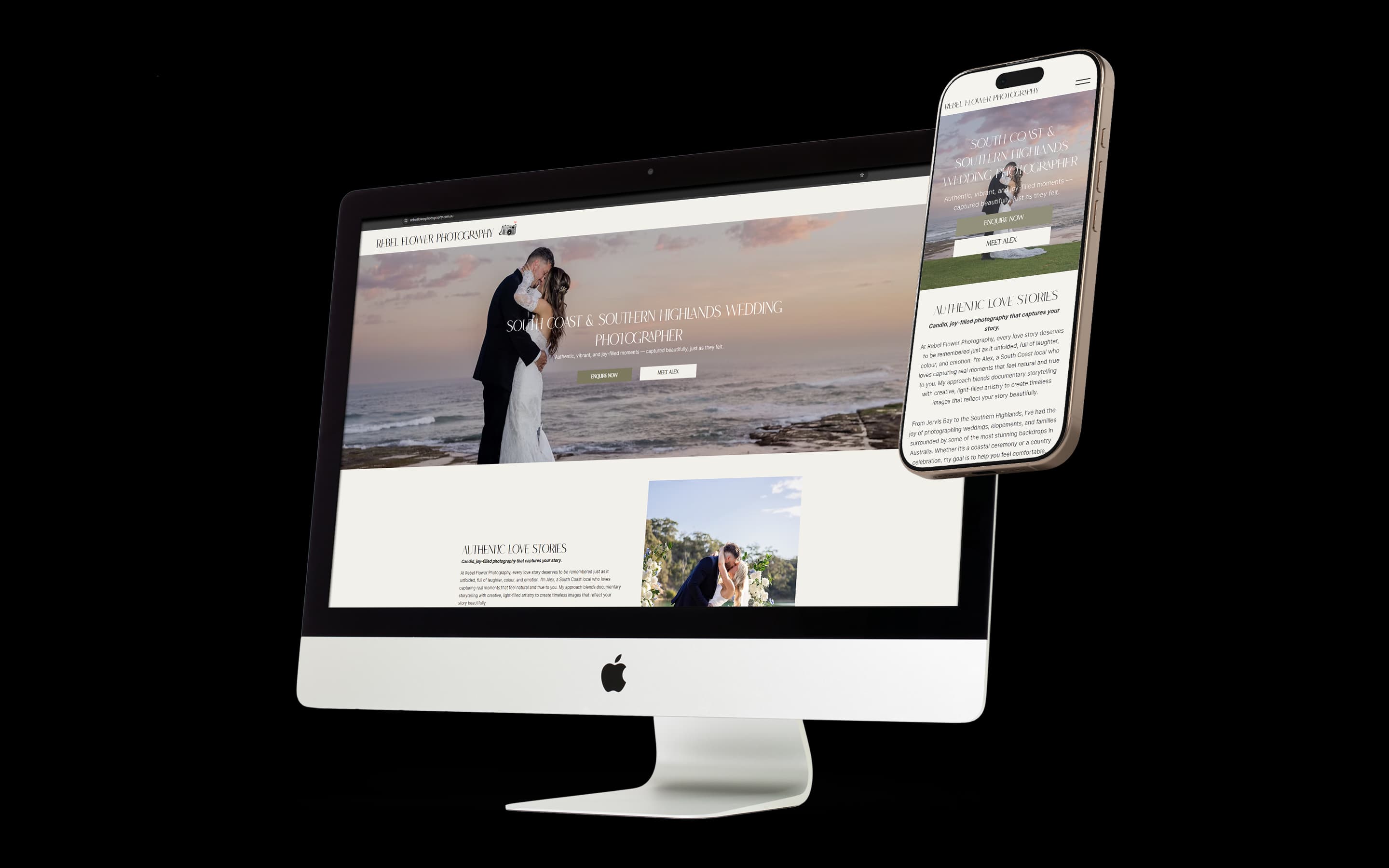
A photographer’s website we’ve built
Rebel Flower Photography
A wedding photography business where the site had to carry the work without getting in its way. Curated galleries that load properly on a phone, packages set out clearly, and an enquiry form that asks for the date first so the conversation can start with a real answer.
Common mistakes on photographers’ websites
Enormous unoptimised images
Straight-out-of-Lightroom exports on a web page. It’s the most common technical fault in the industry and it costs both visitors and rankings.
Showing everything
Two hundred images across nine galleries. A tight edit of forty says more about your judgement than volume ever does.
No pricing at all
Produces a high volume of enquiries from people who were never going to book, and a lot of unpaid time spent finding that out.
Portfolio with no obvious way to enquire
Beautiful work, and the contact link is one word in a collapsed menu.
No text on the page
An all-image site gives Google nothing to read and ranks for nothing. Well-written copy about your approach does double duty — it ranks, and it’s what clients are actually trying to work out.
How much does a photographer’s website cost?
From $800Photography sites sit near the entry point structurally — the page count is modest. What takes the work is the image handling: getting a portfolio that looks uncompromised and still loads fast is a genuine technical exercise, and it’s the part most templates get wrong.
Full pricing →Frequently asked questions
What photographers ask us most before getting a quote.
No. Done properly, images are delivered in modern formats at the right resolution for each device. Visually indistinguishable, a fraction of the file size.
A starting price at minimum. It costs you a few enquiries you didn’t want and gains you better ones.
Yes — galleries are built to be updated without needing us.
In photography, it’s one of the few industries where a blog genuinely earns its place. Publishing full shoots creates pages that rank for venue names, locations and styles, and those searches convert well.
Those are usually better handled by a dedicated platform. We connect the site to whatever you’re using rather than rebuilding it badly.
Two to four weeks, and it goes faster than most builds because you already have the imagery.
We build for other service businesses too —
A site that does your work justice
Tell us what you shoot and who you want to book. We'll show you a homepage concept before you commit.