
Plumber Web Design
When someone’s got water coming through the ceiling, they call the first plumber they can actually get hold of. Your website’s job is to make that you.
Get free quote














Plumbing is one of the few trades where a website can be measured almost in real time. Someone searches, lands on your site, and either calls within about thirty seconds or goes back and calls someone else. There’s no consideration period and no second visit.
That makes plumber websites unusually easy to get right and unusually easy to get badly wrong. Most of the ones we’re asked to rebuild aren’t ugly. They’re just built on the assumption that visitors will read them — and a customer standing in an inch of water is not reading anything.
What a plumber’s website actually needs to do
Get the phone number in front of someone in under three seconds
Tappable, at the top, visible before any scrolling, on every page. Not in a header that collapses into a menu icon. Not on a contact page one click away. The single most common reason a plumbing site underperforms is that calling requires effort.
Handle emergency and planned work differently
A burst pipe and a bathroom renovation are two completely different customers. One needs a phone number and an answer about how fast you can get there. The other wants to see finished work, understand the process, and think about it for a fortnight. A site built entirely for one loses the other, and the planned work is usually where the margin is.
Make your service area unmistakable
"Servicing the Illawarra" means nothing to someone in Albion Park wondering if you’ll come out. Name the suburbs. It answers the question that’s actually stopping them calling, and it’s what makes you findable for "plumber [suburb]" searches.
Say what happens after hours
If you take emergency calls at 2am, that needs to be one of the loudest things on the site — it’s a genuine differentiator and it’s what the highest-value searches are looking for. If you don’t, say that too. Being called at 2am by someone who assumed otherwise helps nobody.
Show your licence
Your plumbing licence number, visible. Most trades sites bury it in a footer. Customers who’ve been burned before look for it, and it costs you nothing to make it easy to find.
Be honest about pricing
You don’t need a price list. But "call-out fee from $X" or "we quote before we start" removes the single biggest reason people hesitate before dialling — the fear of an open-ended bill.
What we build into plumber websites
- Click-to-call buttons that stay visible while scrolling on mobile
- A dedicated emergency plumbing page, structured for urgent searches
- Individual pages for the services worth ranking for — hot water systems, blocked drains, leak detection, gas fitting, bathroom renovations
- Suburb and service-area pages where there’s genuine search volume
- Before-and-after galleries for renovation and bigger jobs
- Licence number, insurance and any trade accreditations displayed properly
- Google review integration so recent reviews show on the site
- Enquiry forms that reach your phone, not just an inbox you check at night
- Integration with job management software — ServiceM8, Tradify, simPRO — so leads land where you already work
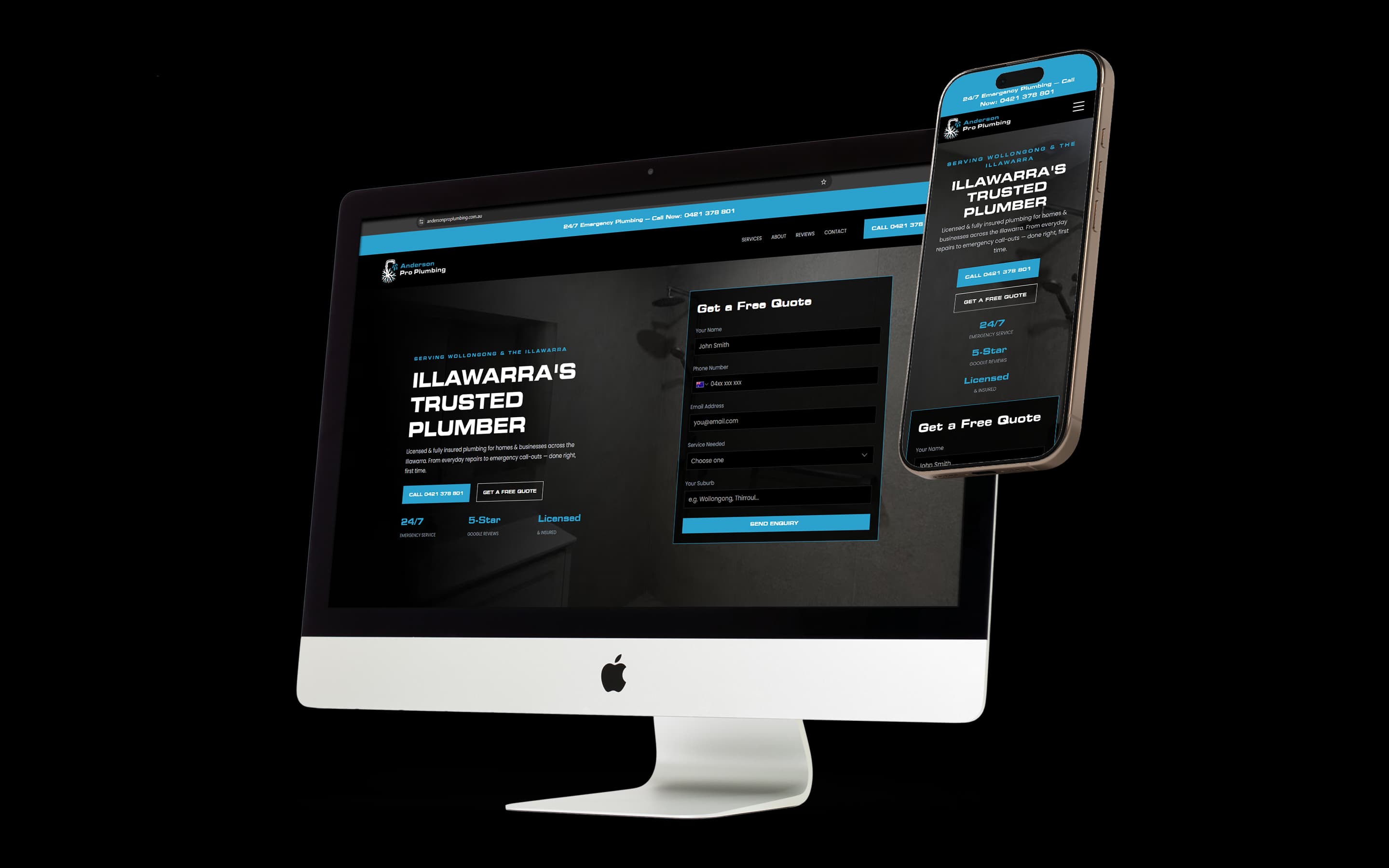
A plumber’s website we’ve built
Anderson Pro Plumbing
Anderson Pro Plumbing offers 24/7 emergency call-outs across the Illawarra, so the site puts the phone number and a sticky “24/7 Emergency” banner in front of every visitor, on every screen. Services are split clearly between urgent work and planned jobs — hot water, renovations, gas fitting — so one doesn’t drown out the other, and a prominent service-area list supports the suburb-specific searches this trade lives on.
Common mistakes on plumbing websites
A hero image of a smiling stock-photo plumber and no phone number
It happens constantly. The most valuable pixels on the page, spent on decoration.
Photos of pipes
Nobody is choosing a plumber based on a close-up of copper fittings. Photos of finished bathrooms, your actual van, your actual team — those build trust. Pipework doesn’t.
A site that’s slow on mobile data
Your customer is often outside, on a phone, on three bars. A site that takes eight seconds to load has already lost them, and heavy uncompressed images are almost always the cause.
Eleven services in one paragraph
If everything is on one page, nothing ranks. Google can’t tell what the site is about, and neither can the customer.
No service area
The most common question a plumbing customer has is "do you come to me," and a surprising number of sites don’t answer it anywhere.
How much does a plumber’s website cost?
From $800Most plumbing businesses sit near the lower end, because the site doesn’t need to be big — it needs to be fast, clear, and easy to call from. A focused site covering your main services, your area and your emergency offering does the job.
Cost moves if you want individual pages for a lot of services or suburbs, job management software integration, or online booking for planned work.
Frequently asked questions
What plumbing business owners ask us most before getting a quote.
Fewer than most people expect. A strong home page, a page for each service worth ranking for, an emergency page, an about page and a contact page covers most plumbing businesses well.
Partly. Those searches are dominated by the Google map pack, which is driven mostly by your Google Business Profile and reviews rather than your website. A well-built site supports it, but if map pack visibility is the goal, the Business Profile is the bigger lever — and we’ll say so rather than sell you a website that can’t fix it.
Yes. Enquiries can flow straight into the system you already use, which matters — a lead sitting in an inbox at 9pm often doesn’t get followed up.
No. Phone photos of real work beat stock imagery every time, and we can clean them up. Send whatever you’ve got.
Most plumbing sites are two to four weeks from first conversation to live, depending on how quickly feedback comes back.
We build for other trades and service businesses too —
Get more calls from the searches that matter
Tell us about your business and where you work. We'll show you what your site could look like before you commit to anything.